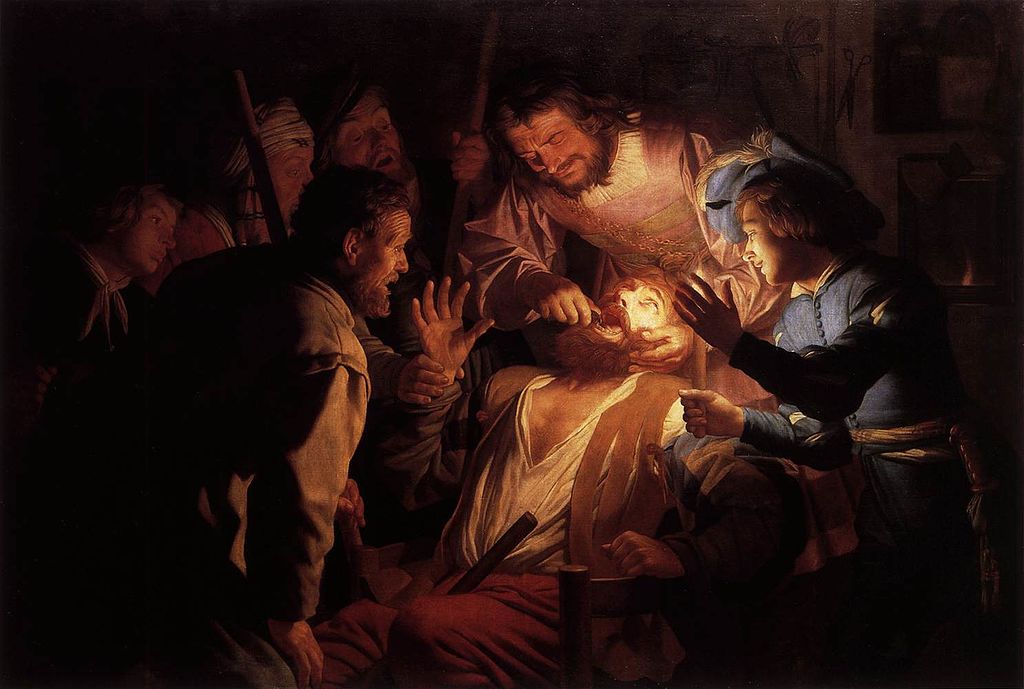
I’ve got a tooth that has given me much trouble over the years, and a trip to the dentist is in order again. It got me thinking about how far dentistry, and modern medicine in general, has come over the centuries. I thought I’d share some scenes from art history with you.
Above is Gerrit von Honthorst’s painting The Dentist from 1622. I’m grateful that dentistry has advanced greatly since the Baroque age. Who ever heard of dentistry in a dark room at night lit by a single candle? Honthrost was a Dutchman who spent his early painting years in Italy admiring the work of Caravaggio and used light in a similar fashion. The candlelight creates a much more dramatic scene, lighting up the faces of the gawkers, one of whom holds back the hand of the tortured man in the chair. Extractions were common and caused excruciating pain before anesthesia was invented in the mid-19th century. Novocain was invented in 1905, around the same time that people started using toothbrushes and toothpaste.
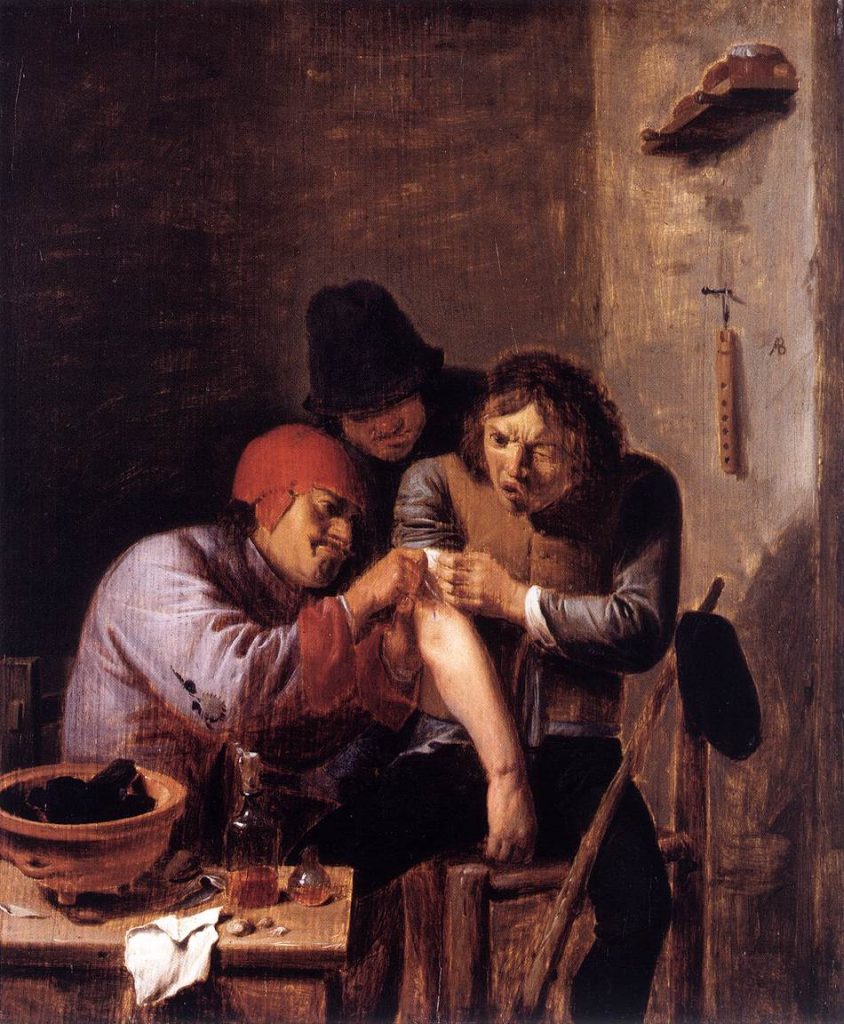
Medicine has come a long way too, as evidenced by Adriaen Brouwer’s painting Feeling from 1635. Here we see a Chinese doctor operating on a patient in the corner of a Dutch tavern, while a crony pokes his head between the two to get a better look. Given his shabby outfit and the unsanitary conditions, we suspect that the doctor is not on the up-and-up. Brouwer mostly painted genre scenes/studies of exaggerated facial expressions, this one being a study of excruciating pain.
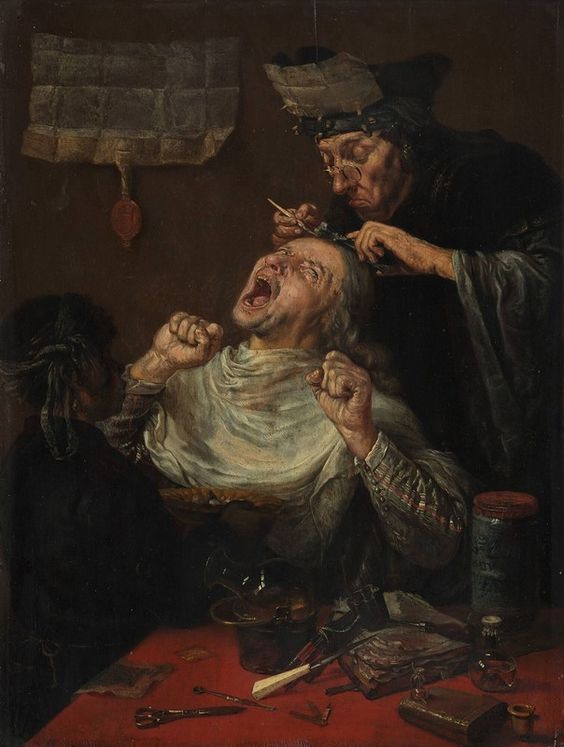
In medieval and Renaissance Europe it was a commonly held belief that madness resided in the ‘Stone of Madness’ or the ‘Stone of Folly,’ a hard lump thought to be found in the prefrontal cortex. Charlatan doctors would perform a surgery to extract this ‘stone’ from the patient who exhibited behaviors of mental illness, depression, stupidity, or dementia. These doctors performed a trepanation, which is scraping out a burr hole in the skull. In ancient times trepanation was believed to release evil spirits that caused madness.
No one has been able to definitively attribute this painting Extracting the Stone of Madness to a particular artist, although we know that it is from 17th Century Holland. The quack leans in over the patient, who screams out in agony; after all, this was before anesthesia and must have been quite a painful procedure to endure. The table is littered with the doctor’s tools of the trade and a servant boy stands at the ready to receive the stone upon extraction.
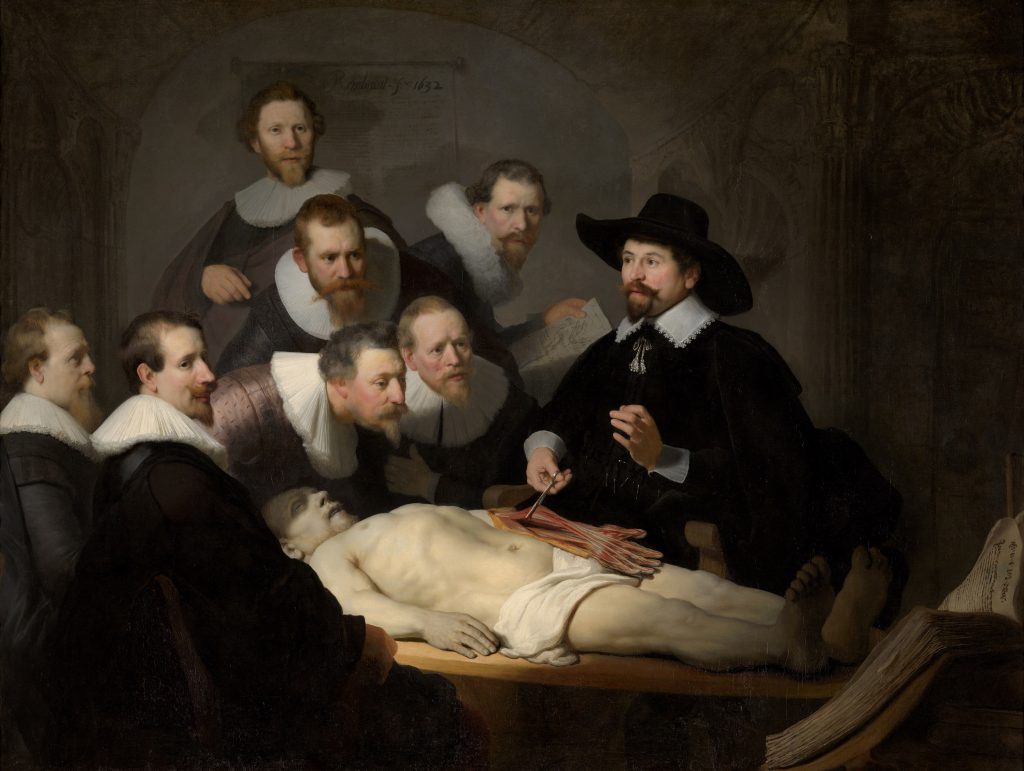
Not all medical practitioners operated in backrooms of taverns in 17th Century Holland. Rembrandt gives us a portrayal of professional doctors working to understand the inner workings of the body in his painting The Anatomy Lesson of Dr. Nicolaes Tulp from 1632. Here we see the members of the Amsterdam Guild of Surgeons as they perform their annual public dissection.
They are dissecting the body of a man who has just been hanged for criminal acts. There probably would have been many more people present at the dissection and Dr. Tulp would have had an assistant do the actual work, but Rembrandt has ingeniously brought focus upon the doctor by placing him in an active role, front and center. There is an anatomy book placed at the body’s feet that represents the interest in science and learning during the Baroque era.
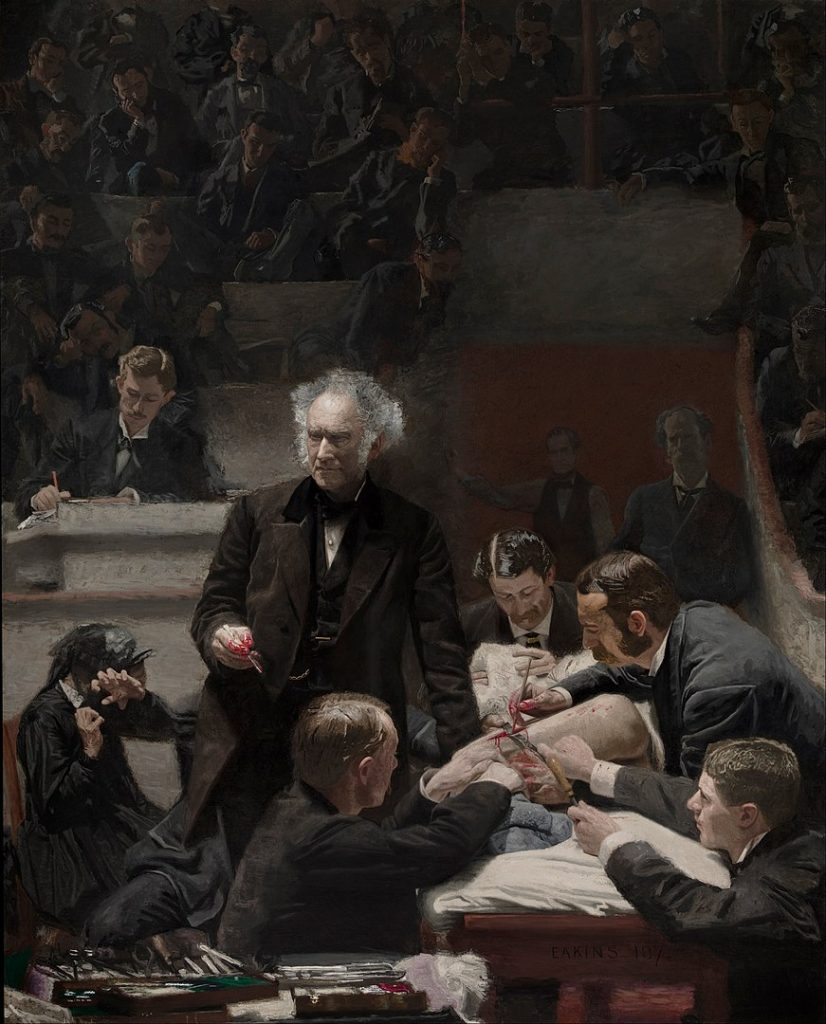
Education in medicine has advanced across generations and continents. American painter Thomas Eakins famously painted The Gross Clinic in 1875. Dr. Samuel Gross was a professor of surgery at Philadelphia’s Jefferson Medical College in the 19th C and is seen here with blood on his hand presiding over a surgery on a teenage boy’s thigh. At the time, Dr. Gross had come up with a new surgical procedure to treat bone infections. No one is wearing surgical gloves; germ theory (and the fact that bacteria cause infections) only became standard knowledge in the 1880’s.
The amphitheatre of doctors and medical students all take a cold, unfeeling approach to looking at the operation in action, and so they should. It wouldn’t do to have doctors shielding their eyes from the sight of blood like the mother of the teenage boy here does. We identify with her because we aren’t accustomed to the sight of open flesh either.
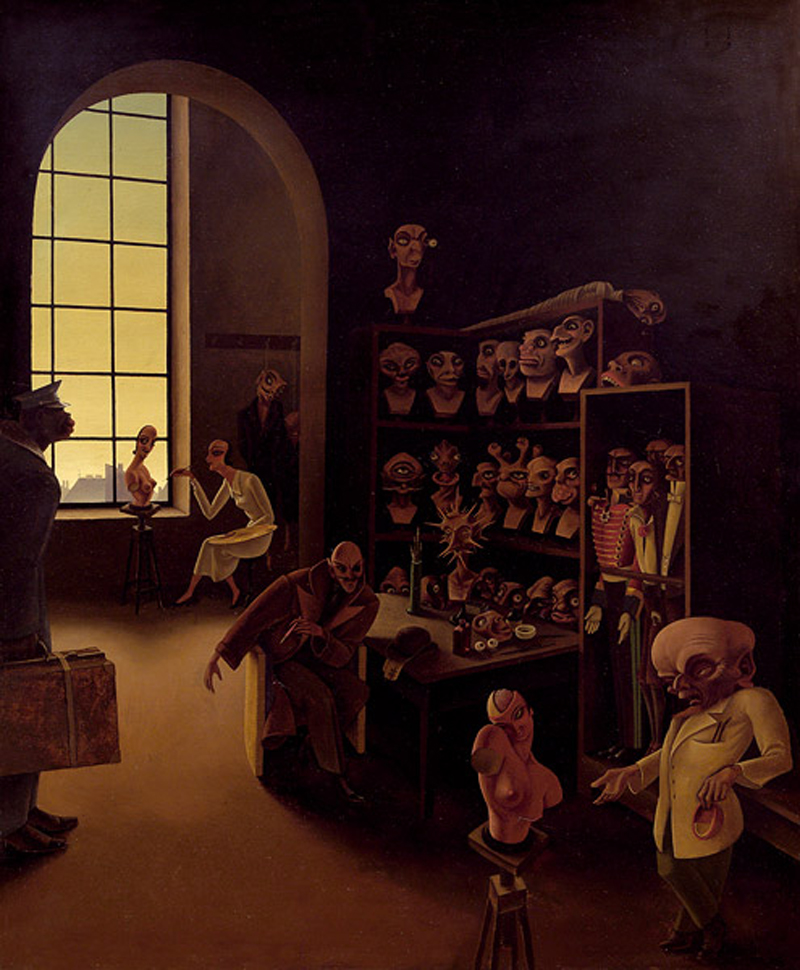
Another interesting tangent in paintings of medical advancement is Franz Sedlacek’s Moulage Studio from 1932. Moulage is the practice of making models for medical study. Historically the models were made from wax and felt lifelike, so that doctors could be properly trained to identify and treat diseases such as tuberculosis and leprosy.
Sedlacek gives us a scene where a well-dressed sinister-looking man arrives with his porter, valise in hand, at the moulage studio. A woman is painting a half mannequin in the back room. Busts and fully-costumed mannequins fill the shelves and closet. The “doctor” who runs the studio has removed the top half of a skull from a mannequin and is showing off the merchandise to the newly arrived customer, but what does the customer want with it?
Goodness, I just realized that all these paintings are incredibly dark, which is stark contrast to a typical clinical setting today. Thank goodness.